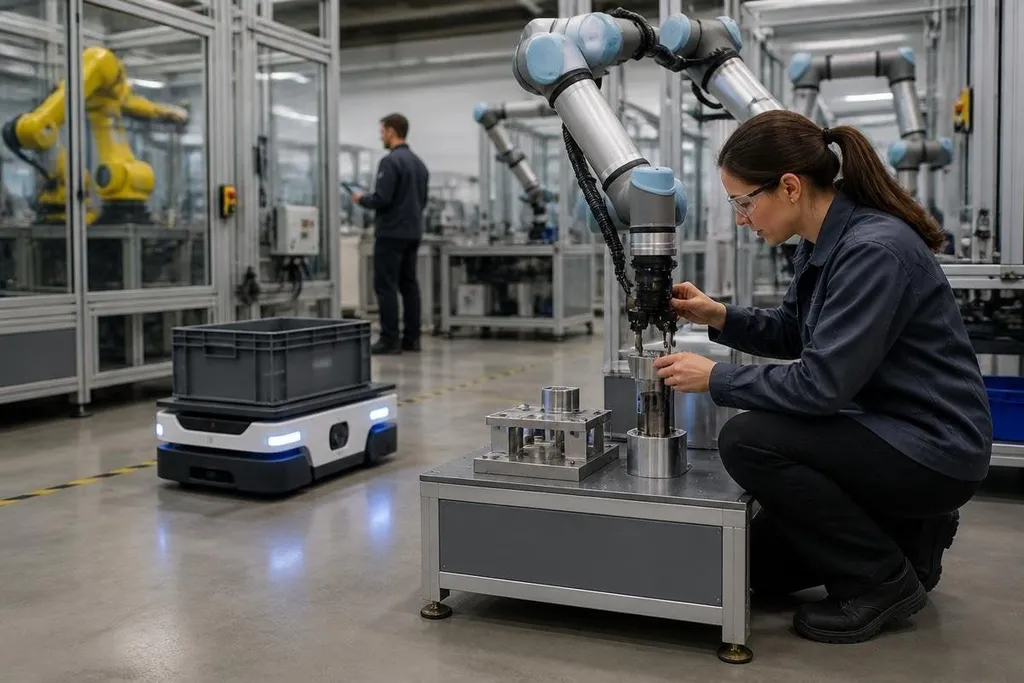
Factory robots are moving beyond fixed arms that repeat one path beside a conveyor. The changes worth watching concern how machines see parts, handle force, move through shared work areas, and connect to factory software.
If you manage production, the useful question is practical: can a robot handle more work without adding a new source of stoppages?
Quick read
- Vision systems are helping robots locate parts that arrive in different positions.
- Force control lets an arm adjust its grip during fitting, sanding, or insertion.
- Mobile robots can carry parts between work cells instead of staying beside one machine.
Vision that deals with change
A traditional robot expects a part to arrive at a known place. A camera system can find the part first, then send its position to the robot controller. That matters when bins are refilled by hand or parts shift on a tray.
The useful change is not the camera alone. The robot also needs software that can turn an image into a safe movement, check whether the part is damaged, and send a fault to a person when the image is unclear.
For a factory team, this can cut the need for custom fixtures.
It also adds new work during setup: lighting, camera position, part color, and dust can affect the result. A vision system that works on Monday may need new settings after a product change.
Arms that feel their way through a task
Position control tells a robot where to move. Force control adds a sense of pressure, so the arm can react when a part does not enter as expected. The system measures force at the wrist or through motor data, then changes the motion.
That fits tasks such as pressing a cover into place, inserting a connector, sanding a surface, or holding a part while another tool works on it. The robot can stop when force rises past a set limit, which helps protect the part and the tool.
The limit is speed and setup time. A force-controlled task still needs a target force, a safe range, and a clear response to failure. Those settings must come from the process, not from a product sheet.
Mobile robots between work cells
A fixed arm can do one job well, but it cannot carry a finished part to the next station. A mobile robot can use wheels, LiDAR, cameras, or floor markers to move through the factory and stop at set points.
This changes the layout question. Instead of adding a conveyor, a plant can test a route between machines and adjust it when work moves. The route still needs marked safety zones, charging space, and a plan for blocked aisles.
That makes dated factory trials more useful than broad claims. Factory robotics reports from Robot24.com can tie a robot’s task to its maker, site, and result before the article turns to robots working beside people.
Robots working beside people
Collaborative robots are built to share a work area with people under defined safety conditions. Their value depends on the task, the tool, the payload, the speed, and the risk from the part being handled.
A cobot may suit machine tending, inspection, or light assembly where a person still loads parts or makes a judgment. It may be a poor fit for heavy work or a fast cycle, where guarding and a fixed industrial arm can give a safer process with a shorter cycle time.
The label alone doesn't settle the safety question. A full cell check must include the gripper, sharp edges, pinch points, restart behavior, and the stop system.
Software that links the cell to the plant
The next area to watch is the connection between a robot and the rest of production. A controller may need to read a machine signal, confirm a part is ready, record a fault, and send cycle data to a factory system.
That connection affects daily work more than a polished demo. If an operator cannot see why the robot stopped, a small sensor fault can become a long pause. Clear logs and local controls give the team a faster way to find the cause.
A practical buying check
Use these questions before choosing a factory robot:
- Name the task: Write the start condition, the handoff, and the pass result.
- Measure the load: Record part weight, tool weight, reach, cycle time, and shifts per day.
- Test bad inputs: Include a missing part, a blocked route, a loose fixture, and a failed sensor.
- Check the cell: Review guarding, stop controls, restart steps, and access for maintenance.
- Price the whole system: Add tooling, fixtures, software work, training, service, and spare parts.
I'd skip any proposal that shows a perfect cycle but leaves these failure cases unanswered.
Factory robots will earn their place through repeatable work, clear fault handling, and a cost that fits the process. The next proof is simple: run the target task for a full shift, count the stops, and compare that number with the manual process.